
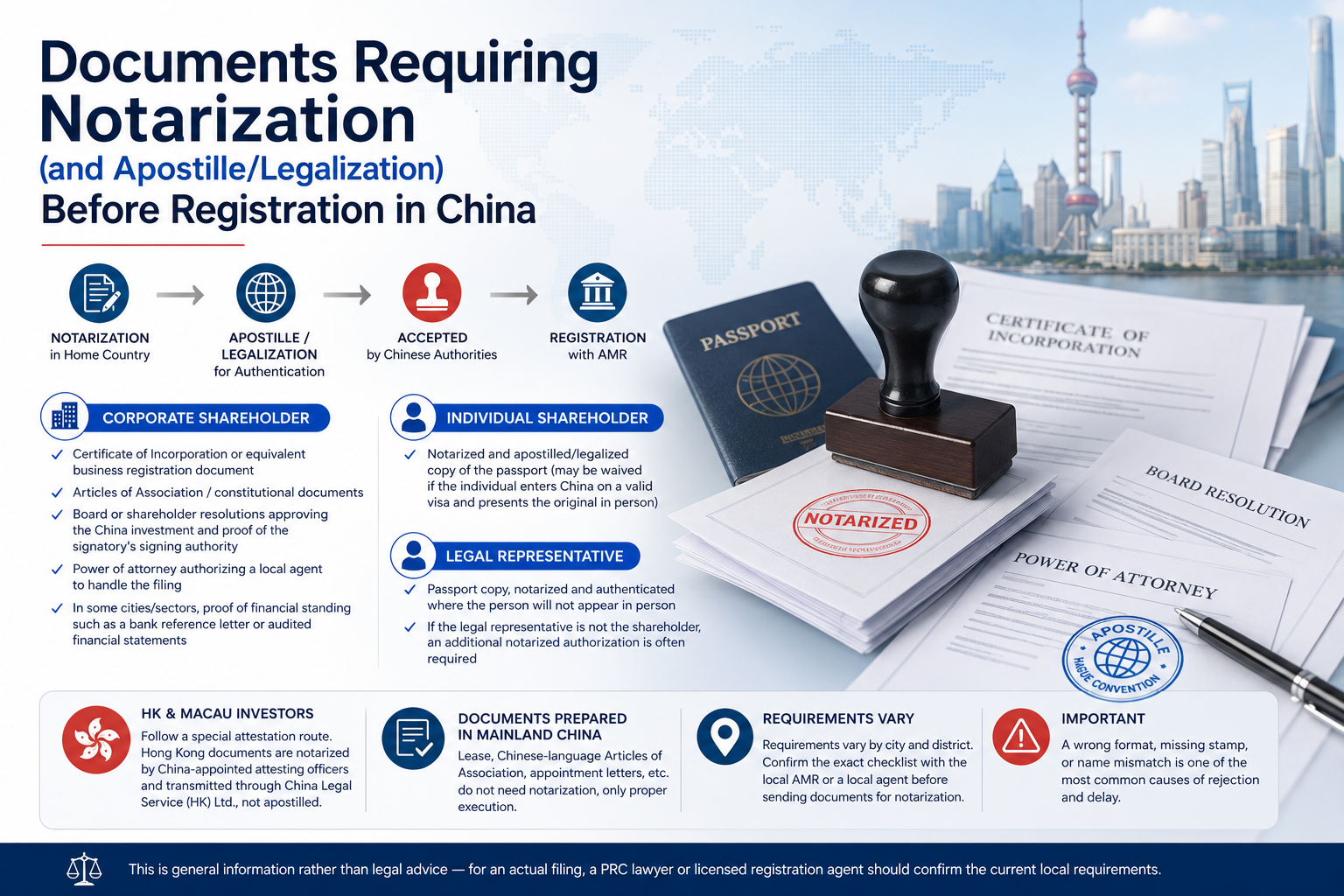
Foreign-issued documents must be notarized in the home country and then authenticated before Chinese authorities will accept them. Since China joined the Hague Apostille Convention in November 2023, a single apostille certificate replaces the old consular legalization through Chinese embassies for investors from Convention member countries; investors from non-member countries still need notarization followed by Chinese embassy/consulate authentication. All documents must also be translated into Chinese.
The core documents requiring this treatment are:
For a corporate (foreign company) shareholder:
- Certificate of Incorporation or equivalent business registration document of the foreign parent — notarized and apostilled/legalized in the country of issuance.
- Articles of Association / constitutional documents of the foreign parent.
- Board or shareholder resolutions approving the China investment and proof of the signatory’s signing authority.
- Power of attorney authorizing a local agent to handle the filing — as a private document, it becomes eligible for apostille once the signature is notarized.
- In some cities/sectors, proof of financial standing such as a bank reference letter or audited financial statements.
For an individual (natural person) shareholder:
- A notarized and apostilled/legalized copy of the passport — though some registration authorities waive this if the person enters China on a valid visa and can present the original in person.
For the legal representative (and sometimes directors/supervisors):
- Passport copy, notarized and authenticated where the person will not appear in person; if the legal representative is not the shareholder, an additional notarized authorization is often required.
A few practical notes: Hong Kong and Macau investors follow a special attestation route (Hong Kong documents are notarized by China-appointed attesting officers and transmitted through China Legal Service (HK) Ltd. rather than apostilled), while documents prepared inside mainland China — the lease, the Chinese-language Articles of Association, appointment letters — do not need notarization, only proper execution. Requirements also vary somewhat by city and district, so it’s worth confirming the exact checklist with the local AMR or a local agent before sending documents for notarization, since a wrong format, missing stamp, or name mismatch is one of the most common causes of rejection and delay.
This is general information rather than legal advice — for an actual filing, a PRC lawyer or licensed registration agent should confirm the current local requirements.