
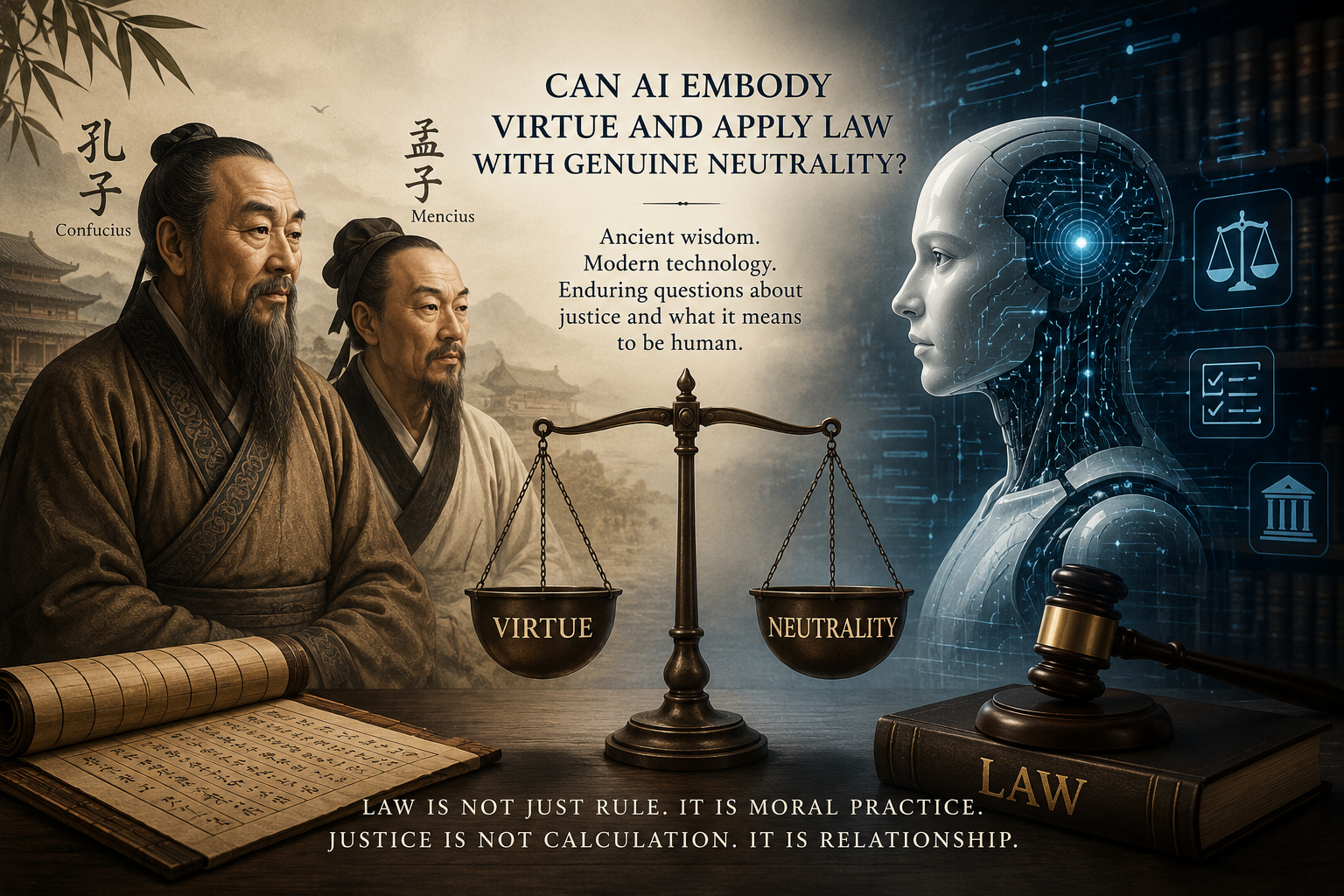
Both Confucian and Mencian thought have exerted a profound and enduring influence on Chinese culture and ethics.
This post examines what these two philosophical traditions might contribute to contemporary debates about artificial intelligence in law — specifically, whether AI can embody virtue and apply law with genuine neutrality.
Can AI Embody Virtue?
Mencius said that virtue arises from four innate moral sprouts: compassion, shame, modesty, and moral judgment. These qualities are felt, lived, and relational — rooted in the depth of human emotional experience. AI possesses none of this. It may simulate virtuous behavior, but simulation is not possession. A Confucian scholar would argue that algorithmic judgment, however precise, is hollow at its core: it lacks the moral character that alone legitimizes authority.
“A Chess engine may play perfect chess, yet it has no love of the game”
An AI adjudicator may apply rules flawlessly, yet it has no love of justice. Competence without virtue is not wisdom — it is mere mechanism.
Can AI Apply Law Neutrally?
AI systems learn from historical legal decisions — decisions made by human beings embedded in societies marked by racial, gender, class, and colonial bias. The consequences of this are not hypothetical. The COMPAS recidivism tool used in the United States, for example, systematically rated Black defendants as higher risk than white defendants with comparable profiles, illustrating how inherited bias can be encoded and amplified by algorithmic systems.
Nor does the problem end with historical data. Every AI legal system reflects the choices of its designers: which factors are deemed relevant, how they are weighted, and what outcomes are optimized for. These are not technical decisions — they are moral and political ones. Neutrality, therefore, is not a design option; it is a myth. Someone always chooses the values the system encodes. The question is only whether those choices are made transparently or concealed behind a veneer of objectivity.
Neutrality as a Myth: Where Confucian and Mencian Thought Converge
Both traditions arrive at the same conclusion: law has never been neutral. The meaningful question is not whether law reflects values, but whose values it reflects and whether those values are openly deliberated or quietly assumed.
Mencius wrote:
“The way of learning is nothing else but to seek for the lost mind.”
If AI displaces the moral effort required of legal reasoning, we risk losing precisely that mind. We risk becoming moral dependents rather than cultivating the self-discipline of superior persons. Virtue, for both Confucius and Mencius, is not a product to be delivered, it is a practice to be sustained through daily effort and genuine human engagement.
A Convergent Warning
What is remarkable is that Confucius, Mencius, Aristotle, and contemporary legal philosophers converge on the same caution regarding AI decision-making:
Morality is not a product to be delivered, it is a practice to be lived. Justice is not an output to be calculated, it is a relationship to be honored. When machines supplant that practice and that relationship, we do not become more just. We become less human.
Moral Courage and Ethical Independence
The legal profession demands more than correct rule application. Lawyers are called upon to refuse client instructions that cross ethical lines, to speak truth to power, to expose institutional wrongdoing, and to take unpopular cases in the service of justice, often without financial reward. These acts require moral courage, a virtue AI is constitutionally incapable of possessing. An AI system would serve whoever deployed it, with no independent ethical conscience and no capacity for principled dissent.
What Is Law For?
The deeper question is not whether AI can perform legal tasks. It is what law is for. If law exists primarily to process disputes efficiently, AI may well assume much of that function. But if law exists to embody justice as a distinctly human moral achievement, one requiring judgment, empathy, courage, and accountability, then AI can be no more than an instrument in service of that achievement. It cannot be its author.