
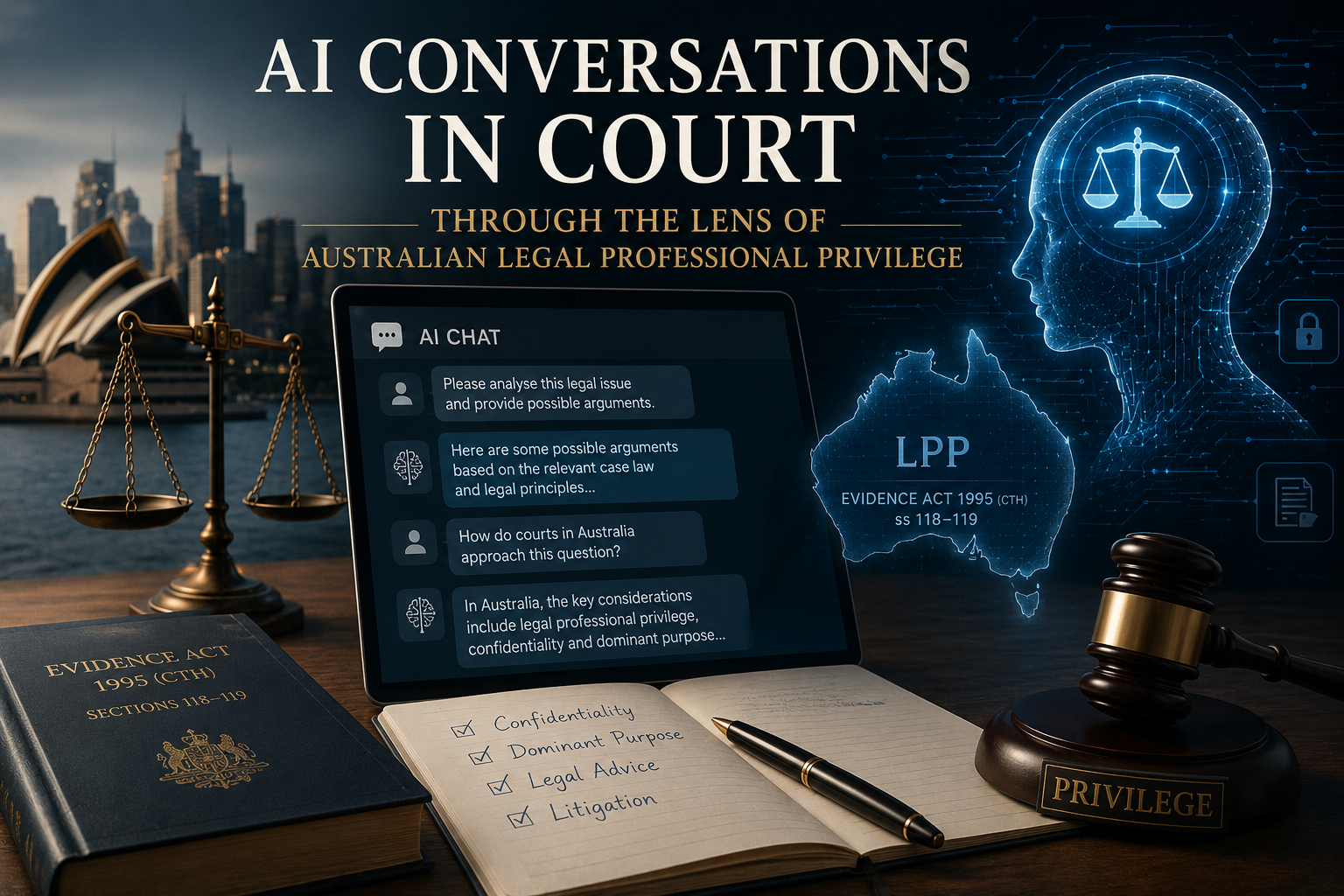
In February 2026, two US federal courts issued landmark rulings on the same day, reaching opposite conclusions about whether a litigant’s AI-generated materials must be disclosed in legal proceedings. Together, United States v. Heppner and Warner v. Gilbarco, Inc. mark the beginning of a new and unsettled area of law at the intersection of artificial intelligence and litigation discovery. While these decisions are American in origin, their implications resonate strongly in Australia, where the principles governing legal professional privilege and discovery obligations share common roots — but carry distinct features that may produce different outcomes.
The Australian Framework: Legal Professional Privilege and Discovery
In Australia, legal professional privilege (LPP) — also referred to as client legal privilege — is both a common law right and a statutory protection. At the federal level, it is codified in sections 118 and 119 of the Evidence Act 1995 (Cth), with equivalent legislation across most states and territories. LPP is a fundamental right that vests in the client, not the lawyer, and protects confidential communications and documents from compelled disclosure in both court proceedings and pre-trial processes such as discovery.
Australian law recognises two distinct limbs of LPP. Advice privilege protects confidential communications between a lawyer and client made for the dominant purpose of obtaining or providing legal advice. Litigation privilege protects confidential communications prepared for the dominant purpose of use in actual or reasonably anticipated litigation. Both limbs require that the communication be confidential and that the dominant purpose — meaning the ruling, prevailing, or most influential purpose, as established in Esso Australia Resources Ltd v Commissioner of Taxation — be one directed at legal advice or litigation.
Critically, LPP can be waived. Following the High Court’s decision in Mann v Carnell (1999) 201 CLR 1, the test for waiver turns on whether the client’s conduct is inconsistent with maintaining confidentiality. Waiver may be express or implied, and is assessed objectively — meaning that even inadvertent or unintentional disclosure can strip a communication of its privilege if a court finds the conduct objectively inconsistent with preserving its confidential character.
The US Cases: Heppner and Warner
In United States v. Heppner, Bradley Heppner, a criminal defendant, used the consumer version of Anthropic’s Claude to prepare documents outlining potential defence strategies while under government investigation. He later shared these materials with his lawyers. Judge Jed S. Rakoff of the Southern District of New York ordered their production, rejecting both attorney-client privilege and the work product doctrine. The court found that no privilege could arise between a user and an AI platform, and that Anthropic’s privacy policy — which expressly reserved the right to share user inputs with third parties and government authorities — meant Heppner had no reasonable expectation of confidentiality from the outset.
In Warner v. Gilbarco, Inc., decided the same day, Magistrate Judge Anthony Patti of the Eastern District of Michigan reached the opposite conclusion. Sohyon Warner, a self-represented litigant (known in Australia as a litigant in person) in an employment discrimination case, had used ChatGPT to research legal issues and draft court filings. The court held that her AI materials were protected as work product because she was, in effect, acting as her own counsel, and because disclosing material to an AI tool is not the same as disclosing it to an adversary. The work product doctrine in the United States requires waiver to occur through disclosure to an opposing party or in a way likely to reach one — and the mere use of a third-party AI platform does not satisfy that test.
Principles in Australia
The reasoning in both cases maps meaningfully onto Australian LPP doctrine, but with important differences that Australian practitioners and litigants must understand.
Confidentiality as the threshold requirement
In Australia, confidentiality is not merely a factor in the privilege analysis — it is a prerequisite. A communication that lacks confidentiality cannot attract LPP at all. The Heppner court’s reasoning on this point aligns closely with the Australian approach: Anthropic’s privacy policy, which allows data to be shared with third parties, makes it very difficult to characterise inputs to the consumer Claude platform as confidential in the relevant sense. As the Supreme Court of Queensland’s AI guidelines state, information entered into a public AI chatbot “should be seen as being published to all the world.” The Federal Court of Australia’s Practice Note on the Use of Generative Artificial Intelligence (GPN-AI), issued in April 2026, similarly cautions all persons involved in federal proceedings — including self-represented litigants — against inputting confidential or privileged information into public AI tools. An Australian court examining a privilege claim over material uploaded to a consumer AI platform would very likely find, applying Mann v Carnell, that the act of uploading was conduct objectively inconsistent with maintaining confidentiality, thereby destroying any privilege that might otherwise have attached.
The dominant purpose test
Unlike the US work product doctrine, which focuses primarily on whether materials were prepared in anticipation of litigation and at the direction of counsel, Australian LPP requires that the dominant purpose of the communication be either legal advice or litigation. This test applies objectively and is assessed by reference to the circumstances at the time the document was created. A person who uses an AI tool to research their legal position — whether or not they are represented — could in principle satisfy this requirement, provided the dominant purpose was genuinely legal in nature rather than, say, commercial or personal. In this respect, the Warner reasoning has some resonance in Australia: a litigant in person who uses AI to prepare court documents may be able to argue that the dominant purpose of those queries was to assist with anticipated litigation. However, Australian courts would still need to be satisfied that the confidentiality element was preserved, which as noted above remains the critical obstacle when consumer AI platforms are involved.
Implied waiver and the inconsistency test
The Australian waiver doctrine, as confirmed in Mann v Carnell and codified in section 122 of the Evidence Act 1995 (Cth), asks whether the party’s conduct is inconsistent with maintaining privilege. In the context of AI, uploading privileged material or the substance of privileged strategy to a public AI platform — one that retains inputs, may use them for model training, and may share them with third parties — is very difficult to reconcile with an intention to maintain confidentiality. This is a stricter standard in practice than the US work product waiver test applied in Warner, where the court held that disclosure to an AI tool is simply not disclosure to an adversary. Under Australian law, the question is broader: was the conduct inconsistent with confidentiality? Given the terms of service of most consumer AI platforms, the answer is likely yes.
AI output is not legal advice
A further Australian distinction deserves emphasis. Under Australian law, only a person holding a current practising certificate may provide legal advice. Advice generated by an AI tool — however sophisticated — is not legal advice in the relevant sense, and therefore cannot independently create advice privilege. This point, implicit in the Heppner reasoning, is made explicit under Australian professional rules. As the Law Society of the ACT’s guidance states, practitioners must not input confidential or privileged information into public AI tools, and AI output cannot substitute for professional legal judgment.
Court Guidance and Emerging Practice
Australian courts have moved swiftly to address AI use in litigation. In addition to the Federal Court’s GPN-AI Practice Note, the NSW Supreme Court’s Practice Note SC GEN 23 (effective February 2025), the Queensland courts’ AI guidelines (September 2025), and the Federal Circuit and Family Court of Australia Practice Direction on the Use of Artificial Intelligence, issued 29 May 2026, all set clear expectations for AI use in proceedings. The NSW Uniform Civil Procedure Rules were amended in 2025 to prohibit the use of generative AI to write or alter witness statements and affidavits, and to require affidavits to declare that AI was not used in their preparation.
These measures reflect an institutional awareness that AI use in litigation creates genuine risks — to privilege, to the accuracy of court documents, and to the administration of justice more broadly.
Conclusion
The US decisions in Heppner and Warner offer a useful framework for thinking about AI and disclosure obligations, but Australian practitioners and litigants should not assume the outcomes would be identical under Australian law. The Australian LPP framework — with its strict confidentiality requirement, dominant purpose test, and objective inconsistency-based waiver doctrine — presents additional and in some respects higher hurdles to protecting AI-generated litigation materials. Where consumer AI platforms are used, the risk of implied waiver is acute, and the weight of emerging guidance from Australian courts and professional bodies strongly cautions against it. The safer path — consistent with both the letter and the spirit of Australian privilege law — is to confine AI use in legal matters to enterprise-grade, closed platforms with genuine contractual confidentiality protections, deployed within a supervised legal workflow.